
Cheek/Chick DNA Project
Haplogroups:
Historical Origins of the Cheek/Chick Family
The Y-DNA test results indicate that the direct male-line ancestors of the main related groups in our study (both "Family Group 1" and "Family Group 2") were western Europeans, possibly English of Celtic origin (Anglo-Celts) or "Ancient Britons."
There are stories in many Cheek families about Native American ancestry. So far, we have not found genetic evidence of Native American ancestry in the direct male line. A participant could still have Native American ancestors in a different line (e.g. a female ancestor), but this would not show up on a Y-DNA test, because Y-DNA is only passed from father to son. The origin of the Cheek surname, however, is probably English in most cases.
What Are Haplogroups?
DNA testing has revolutionized the way that scientists study human migration. Scientists have collected genetic samples from people all over the world, hoping to understand how populations moved out of Africa (where the human race originated) and into Europe, Asia, and the Americas. Based on these studies, scientists have divided DNA into large "super-families" called "haplogroups." It is possible to predict a person's Y-DNA haplogroup from the results of a 12-marker or 25-marker Y-DNA test, although sometimes an additional test, called a "SNP" (single nucleotide polymorphism) test, is needed for confirmation.
Your Y-DNA haplogroup gives you clues about the geographic origin of your direct male-line ancestors. For example, if your family came from England and your haplogroup is R1b1, your direct male-line ancestors, 2,000 years ago, were probably members of a tribe (possibly Celtic) who lived in the British Isles or somewhere along the northwestern coast of Europe. We can say with 100% certainty that they were not Native Americans, Africans or Asians, and it is highly unlikely that they were Russians, Greeks or Sicilians. It is important to remember, however, that haplogroups are not the same as racial or ethnic groups. Haplogroups overlap national and ethnic boundaries, and most ethnic groups have several different haplogroups in their populations. The R1b1 haplogroup is common throughout western Europe, so you still have to consider other information about your family, such as surname history, patterns of immigration to America, etc. In addition, our ideas about race and ethnicity change over time. No one really thought of the "Celts" (Welsh, Irish, and Scots, etc.) as a single ethnic group until scholars began studying Celtic languages in the 18th century. In ancient times, the "Celts" included many different tribes who spoke their own languages, had their own kings and often fought bitterly with each other.
Another caveat is that this science is truly on the cutting edge, and new developments are happening all the time that could change our understanding of some of the following theories.
With that in mind, the 3 most common Y-DNA haplogroups in the British Isles are:
A fourth haplogroup, E1b1b (previously known as E3b) is rare in the British Isles, but clusters have been found in northern Wales and some other parts of England. It may be evidence of southern Europeans who migrated to Britain during the Roman period.
View map of European Y-DNA Haplogroups
Haplogroup R1b1 (M343, P25) (Western Europeans)
Most of the participants in the Cheek DNA study, including everyone in the main related groups—what we've been calling "Group 1" and "Group 2" (see Results Summary)—are in Haplogroup R1b1. This is the most common Y-DNA haplogroup in western Europe. The frequency of R1b1 is highest along the Atlantic coast of Europe (up to 90% of Welsh, Irish, and Basque populations, for example), and declines as you move east. Haplogroup R1b1 probably originated in a group of people who "wintered" in what is now Spain during the last Ice Age and then moved north when the glaciers melted 10,000 to 12,000 years ago. The ancestors of R1b1 may have been the original Paleolithic people of western Europe, famous for their cave paintings in Lascaux, France and other archeological sites.

Distribution of Haplogroup R1b (Relative Genetics)
Until recently, Haplogroup R1b1 was known as R1b. It is also called "P25" because it is defined by what's called the "P25 mutation." In the book Saxons, Vikings, and Celts, author Bryan Sykes calls R1b1 the "Clan of Oisin."
A subset of the R1b1 haplogroup known as the "Atlantic Modal Haplotype" (AMH) consists of 6 genetic markers that have been found at high frequencies in people from the European Atlantic coast, such as Wales, Ireland, the Orkney Islands, the Dutch province of Friesland, and the Basque country in northern Spain. In the British Isles, the AMH has been associated with the Celts, including English people with Celtic ancestry ("Anglo-Celts"), as well as the Irish, Welsh, and Scots.
Over the past 10,000 years, the British Isles have been home to a wide variety of people, including prehistoric tribes, Celts, Germanic tribes such as the Anglo-Saxons, Vikings from Scandinavia, and the Normans from France, who were basically French-speaking Vikings. Although historians have usually assumed that the "ancient Britons" (Celts and others) were wiped out by the Anglo-Saxon invasions, or were all pushed into Scotland and Wales, genetic studies show that the original native population survived in many parts of England, especially in the southwest and along the southern coast.
In our study, the main related group, or "Family Group 1," matches the AMH on 5 out of 6 markers, and has a 2-step mutation on the remaining marker (a genetic distance of "2"). "Group 2" is also very close to the AMH, matching on 4 markers and having one-step mutations on 2 other markers (also a genetic distance of "2"). This is very consistent with the theory that the Cheeks came from southern England, where we think their surname originated. The Cheek/Chick surname was particularly common in the southwestern counties of Devon, Dorset, and Somerset, which have a long and colorful Celtic history.
One participant in "Group 1" of our study has recently had a "subclade" test to further refine his Y-DNA haplogroup. His test results indicate that the members of Group 1 fall into the subclade (subfamily) of R1b1 known as Haplgroup R1b1b2a1a (also known as the R-U106 subclade). This subclade is most common along the Atlantic coast of Europe, found in about 21% of the male population of England and reaching a maximum concentration of 37% in Frisia (the Netherlands). Current research indicates that R1b1b2a1a branched off from the rest of R1b1 about 7,000 B.C., at the end of the last Ice Age.
In the United States, Haplogroup R1b1 is the most common Y-DNA haplogroup in men of European descent, which is not surprising if most of our ancestors came from northwestern Europe. As of May 2008, nearly 70% of the Y-DNA results submitted to the Ybase website were Haplogroup R1b, while only 17% were Haplogroup I and 7% were Haplogroup R1a. A 2005 study found that 58% of white American men are in Haplogroup R1b.
Haplogroup I1a (P38, P30) (Scandinavians)
The second-most common haplogroup in England is Haplogroup I1a, sometimes called the "Viking haplogroup" because it seems to follow routes of Viking conquest in northern Europe. For example, Haplogroup I1a is significantly more common in parts of England that had historical Viking settlements. A closely related haplogroup, I1b, is found in central and eastern Europe. The ancestors of I1a probably survived the last Ice Age in an isolated pocket of south-central Europe and then moved north when the weather warmed, eventually reaching Scandinavia several thousand years ago. Haplogroup I1a is present in about 35% of the population of southern Norway, southwestern Sweden, and Denmark.

Distribution of Haplogroup I1a (Relative Genetics)
Haplogroup R1a (M17) (Eastern/Central Europeans)
Haplogroup R1a is found throughout Europe, but its frequency declines as you move from east to west—exactly the opposite of Haplogroup R1b1. Haplogroup R1a occurs at highest frequency among the Slavic populations of Russia, eastern Europe and the Ukraine. It is also found in western Asia, central Asia, and India. R1a is the third Y-DNA haplogroup commonly found in England, although it is much rarer than either R1b1 or I1a. Haplogroup R1a probably arrived in England with the Anglo-Saxons who invaded during the 7th and 8th centuries A.D.
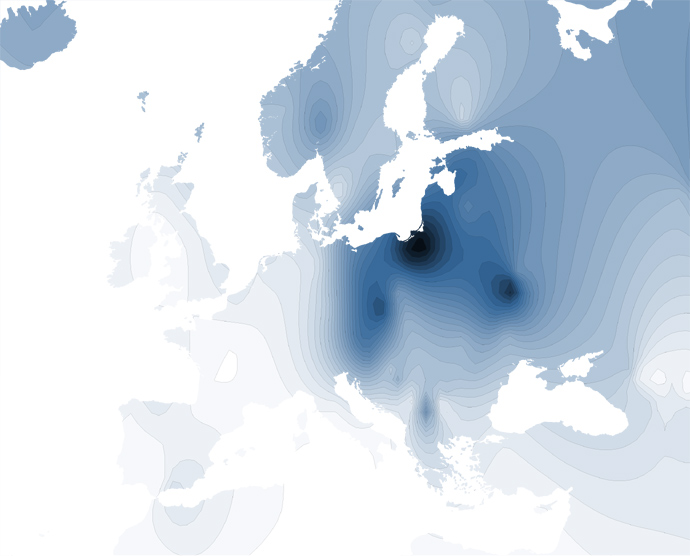
Distribution of Haplogroup R1a (Relative Genetics)
Because of genetic similarities between R1a and R1b1, scientists believe that both lineages are descended from a common ancestral group of people who lived in the Middle East over 30,000 years ago. As these people slowly migrated into Europe and Asia, their populations diverged, with the ancestors of R1b1 traveling west and R1a's ancestors heading east. During the Ice Age the ancestors of R1b1 and R1a became isolated from each other at opposite ends of the European continent. The ancestors of R1b1 survived on the Iberian peninsula—now Spain—while the ancestors of R1a lived on the fertile steppes of what is now the Ukraine. Approximately 6,000 to 8,000 years ago, the ancestors of the R1a lineage began migrating westward into Europe, part of a great movement of people known as the Indo-European expansion. The Indo-Europeans eventually came to dominate the entire European continent. Virtually all modern European languages are part of the Indo-European language family. One exception is the unique Basque language, which is believed to be the only surviving descendant of the lost languages spoken in western Europe before the arrival of the Indo-European tribes.
So where did the "Celts" come from? For a long time, historians believed that the Celtic people of the British Isles were descendants of a tribe of Indo-Europeans who settled in central Europe several thousand years ago. The Romans called them the Gauls, but 18th century scholars took the name "Celts" from the ancient Greek name Keltoi. According to the traditional theory, the Celtic tribes began a period of expansion and military conquest about 3,000 to 5,000 years ago, and eventually conquered much of western Europe and the British Isles. What happened to the "native" western Europeans (the pre-Indo-Europeans) has always been a bit of a mystery.
Some time after the Celts arrived in the British Isles, the "native" Britons disappeared off the face of the earth. They left behind pottery, burial mounds, and some amazing archaeological relics like Stonehenge, but little else—or so it seemed. Genetic studies are now rewriting this history. Celtic people such as the Welsh and Irish speak Indo-European languages, but their Y-DNA is similar to that of the Basques. In other words, the Welsh and Irish appear to be more closely related to the non-Indo-European Basques than they are to Indo-European groups elsewhere in northern Europe, such as Germans and Scandinavians. This does not mean that the Basques were direct ancestors of the Celts or visa versa, but it suggests that the Basques and the Celts have a common origin dating back many thousands of years to pre-historic western Europe, before the arrival of Indo-European tribes. Only the Basques managed to keep their ancestral language alive to the present day. In the British Isles and elsewhere, the people lost their original languages, probably as a result of trade, military conquest, and intermarriage with Indo-Europeans.
According to many scholars, there is no evidence of a Celtic military invasion leading to total population replacement in the British Isles. There were probably periods of warfare and conquest, but other times when people traveled and traded peacefully. Due to these influences, the native population gradually began to adopt Celtic languages and aspects of Celtic culture and technology (such as metal-working). Over time, the ancient Britons adapted and evolved, and finally became the people we think of today as "the Celts."
Haplogroup E1b1b (M35) (the Mediterranean)
The E1b1b haplogroup (previously known as E3b) is common in the Mediterranean region, including North Africa, Spain, Italy, Greece, and Balkan countries such as Albania and Serbia. The ancestors of the E1b1b haplogroup probably lived in the horn of Africa (present-day Somalia) during the last Ice Age and moved into southern Europe via the Middle East during what's called the "Neolithic migration" around 9,000 years ago. The frequency of E1b1b in northern Europe and the British Isles is very low, although it does show up occasionally in people with no known Mediterranean ancestry. Some studies have found clusters of E1b1b in parts of England and especially northern Wales. By contrast, E1b1b is present in about 25% of Silicians and Greeks, and 50%-80% of North Africans. It is particularly common in the Berber people, who live in Morocco, Algeria, Tunisia and Libya. It's also the 2nd most common Y-DNA haplogroup in men of Ashkenazi Jewish descent. The presence of the E1b1b haplogroup in the British population, though relatively rare, is evidence of a past migration of people from southern Europe, possibly soldiers and settlers who arrived during the Roman occupation of Britain in the first three centuries A.D.
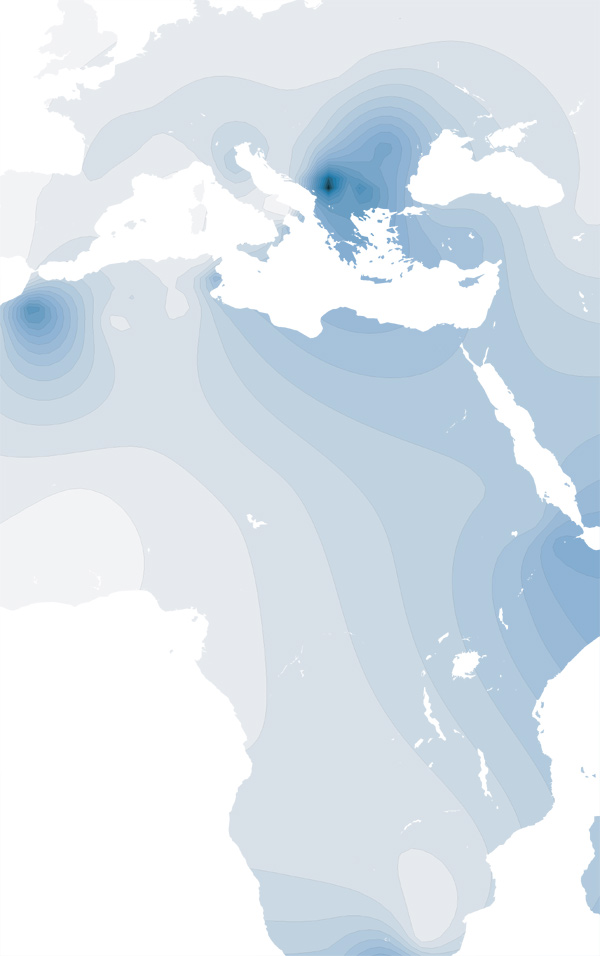
Distribution of Haplogroup E3b (Relative Genetics)
Other European Haplogroups
Other European Y-DNA haplogroups include Haplogroup N2 (Finland and Russia), Q (Norway), G (central and southern Europe), J2 (the eastern Mediterranean and Ashkenazi Jews), and T (the Mediterranean). These haplogroups are very rare in the British Isles outside of immigrant populations, though you can always find a few exceptions.
Mitochondrial DNA
Both males and females have mitochondrial DNA (mtDNA) but it is inherited only from the mother. Mitochondrial DNA can be used to study female-line ancestry, just like Y-DNA is used to study male-line ancestry. Mitochondrial DNA is categorized into haplogroups like Y-DNA, but the letters do not correspond to Y-DNA haplogroups (so don't get confused!). Interestingly, mtDNA haplogroups are not as closely tied to geography as Y-DNA haplogroups. This is probably because in most cultures, women move away to live with their husband's family and not visa versa. Mitochondrial DNA haplogroups are the subject of the book The Seven Daughters of Eve by Bryan Sykes.
The Rest of Your DNA
All the rest of your DNA gets "mixed up" in every generation. That is, you inherit half your DNA from your mother and half from your father. The only exceptions are Y-DNA and mtDNA. You have a 50% chance of inheriting any particular gene from your parents, and your children have a 50% chance of inheriting that gene from you. As a result, DNA tests (except Y-DNA and mtDNA) become unreliable for studying family relationships beyond 2 or 3 generations.
 Family Trees