Deed Abstracts
of Alleghany County, NC
 lleghany County, North Carolina, was established in
1859 from Ashe County, which was established in 1799 from Wilkes
County. To find land transactions prior to 1859, you will
generally need to search the records of either Ashe or Wilkes
County. However, a substantial number of early deeds were
later recorded Alleghany County's deed books. You can browse these
abstracts by year, or use the
every-name index.
lleghany County, North Carolina, was established in
1859 from Ashe County, which was established in 1799 from Wilkes
County. To find land transactions prior to 1859, you will
generally need to search the records of either Ashe or Wilkes
County. However, a substantial number of early deeds were
later recorded Alleghany County's deed books. You can browse these
abstracts by year, or use the
every-name index.
Transcriber's Notes:
- The Alleghany Deed Books can be referred to by letter
or number. Deed Book A is the same as Deed Book 1, Deed
Book B is the same as Deed Book 2, etc.
- Many of the deeds were scribbly and difficult to read, and I am sure I made some errors. It's always good to double-check the original
records yourself. You can look up the original deed images at the Alleghany
County Register of Deeds
 website.
- Finding your ancestor's land on a modern map can be confusing because the names of some geographic features have changed. For example, Cheek Mountain, Fender Mountain,
and Doughton Mountain are relatively modern names;
during the 19th century, the entire ridge in central Alleghany
County was called Peach Bottom
Mountain, as shown on the map below, from 1857 (Sparta's in the wrong place, but you get the idea!)
- Many of the major families in Alleghany County appear on this county map from 1918 (click here) (North Carolina Maps Collection website). Families often lived in the same location for several generations, so this map can be very helpful. More Alleghany County maps are listed here.
- Another source of confusion is that different geographic features may have the same or similar names. Words like Glady, Piney, Brushy, Bald, Round, etc. were very common. There are at least five creeks in Alleghany County named Pine or Piney. Words like Branch, Creek, and Fork were often used interchangeably in the old deeds, and may not be the same on modern maps. For example, Brush Creek, in eastern Alleghany County, was sometimes called Brushy Creek or Brushy Fork of the Little River, which is easy to confuse with Brushy Fork of Prather's Creek in the western part of the county.
- Nevertheless, many creeks and mountains mentioned in the old deeds are found on modern maps, and it is usually possible to identify at least the general location where your ancestor lived. If all else fails, look for deeds involving neighbors and family members.
- Surnames can be spelled very inconsistently in old records. I have tried to include "standard" spellings in brackets wherever possible.
- Unless otherwise noted, you can assume that the grantor and grantee are identified in the deed as residents of Alleghany
County or (prior to 1859) Ashe County, NC. You can also
assume that the land was located in present-day Alleghany
County.
- The "metes and bounds" descriptions have been omitted ("south 10 chains to an oak" etc.) Chains and poles were the standard measurements of distance in traditional surveying. A "chain" is 66 feet, and a "pole" (or rod) is one-quarter of a chain, or 16.5 feet. An acre is 10 square chains.
- "X" means the person signed their name with a mark
instead of a signature. This usually indicates that the
person could not read or write.
- Land descriptions were often copied from earlier deeds, and
aren't always accurate. For example, an 1846 deed from Andrew
Willey to Chesley Cheek (DB 1, p.325) mentions neighboring
properties owned by Lenoir and Connelly, early residents who were
long gone by 1846. In this case, the legal description of
the property was probably copied from the original 1801 land
grant to John Overton (DB 7, p.174).
Organization of these abstracts. I arranged the
abstracts chronologically because that made the most sense to
me. However, the deed books themselves are not in any
particular order. The clerks simply copied the deeds
however they received them, which in some cases was years after
the original transactions took place. The first twenty deed
books cover the following years:
| Book |
In Use |
Oldest Deed |
| A-1 |
1859-1872 |
1816 |
| B-2 |
1872-1881 |
1801 |
| C-3 |
1875-1883 |
1809 |
| D-4 |
1878-1882 |
1846 |
| E-5 |
1879-1886 |
1828 |
| F-6 |
1885-1886 |
1809 |
| G-7 |
1885-1888 |
1801 |
| H-8 |
1888-1892 |
1845 |
| I-9 |
1892-1894 |
1782 |
| J-10 |
1894-1896 |
1801 |
| K-11 |
1896-1898 |
1810 |
| L-12 |
1898-1899 |
1799 |
| M-13 |
1899-1900 |
1797 |
| N-14 |
1900-1901 |
1782 |
| O-15 |
1901-1902 |
1817 |
| P-16 |
1902-1903 |
1811 |
| Q-17 |
1903-1904 |
1804 |
| R-18 |
1904-1905 |
1797 |
| S-19 |
1905-1905 |
1854 |
| T-20 |
1905-1906 |
1805 |
In most cases, the deed's effective date is the date of
the actual sale or other transaction. The abstracts also include
the date the deed was "proven" (i.e., authenticated in
court), and the date it was "registered" (copied into
the deed book), if this information appears in the original
deed.
I have omitted the names of government officials who appear
repeatedly in deed certifications and registrations. These
officials included:
- Allen GENTRY, Clerk of the County Court, 1859-1861
- Horton S. REEVES, Clerk of the County Court, 1862-1868
- Charles G. FOWLKES, Clerk of the County Court, 1866-1868
- William A.J. FOWLKES, Clerk of the Superior Court,
1864-1868
- Berry H. EDWARDS, Probate Judge/Clerk of the Superior Court,
1868-1873
- John J. GAMBILL, Probate Judge/Clerk of the Superior Court,
1873-1882
- R.S. CARSON, Probate Judge/Clerk of the Superior Court,
1882-1890
For the first few years of Alleghany County's existence,
the court clerk was responsible for copying the deeds into the
deed book. Later, this job was given to the Register of Deeds,
often assisted by various Deputy Registers.
- Thomas EDWARDS, Register of Deeds, 1865-1868
- F.M. MITCHELL, Register of Deeds, 1868-1880
- F.G. MCMILLAN, Register of Deeds, 1880-1882
- F.M. MITCHELL, Register of Deeds, 1882-1886
- J.C. ROUP, Register of Deeds, 1886-1892

Copyright Notice. This work is licensed under a Creative Commons Attribution-Noncommercial-Share Alike 3.0 United States License. You are free to copy, distribute, and display this work if you attribute the work to the author and link back to this site. Commercial use is not permitted.
 View the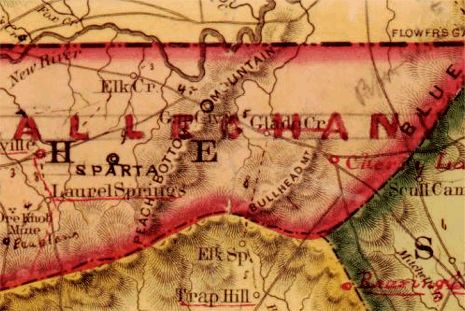

 Google Map